

For the past few years, the technological revolution has taken over the world like never before. Directly or indirectly, we leverage technology in our day-to-day tasks to make our lives more comfortable and efficient. However, there is an unsung hero behind this revolution – Technical communication! It is technical communication that quietly works at the backend to keep the technological progress rolling smoothly from one step to the next. Without this, every Newton and Einstein would have to start from zero.
To further elaborate why technical communication is an essential skill of today’s world, this post discusses technical communication and its various aspects:
- Understanding Technical Communication
- Objectives of Technical Communication
- Characteristics of Effective Technical Communication
- Scope of Technical Communication
- Difference Between Technical Communication and Technical Writing
Understanding Technical Communication
Technical communication refers to a wide field of transferring domain-specific information by experts to a general audience. It also includes instructions about how to do a task regardless of any involvement of technology in the process itself or its transmission.
In other words, technical communication is all about conveying complex technical ideas, processes etc., to a non-expert audience in a comprehensible manner.
In day-to-day life, although unaware, we all participate in technical communications. When you explain the features of the latest mobile phone to your grandpa or tell him how to use a newly bought mixer grinder, you are communicating technical information.
However, in many cases, technical communication takes a formal, structured, and standard approach.
For example, a patient record file has patient-specific details such as age, gender, contact information, a timeline of hospital visits, treatments provided, and lists of prescriptions. This file is valuable to both doctors and patients alike. Doctors can use it to make better treatment decisions and monitor the patient’s progress, while patients can be in the know of their health status and use it later for any other medical requirements.
Objectives Of Technical Communication
Undoubtedly, the advancement of science and technology has boosted technical communication as a specialized discipline. However, its objectives and scope go way beyond science and technology. The nature and extent of information also depends on the audiences’ needs which is again varied. Still, we can broadly categorize the objectives of technical communication:
- To inform: The first purpose of technical communication is to pass on the knowledge from an expert to those who are newer to the subject, which includes answering users’ questions and helping them solve a problem.
- To instruct: Technical communication also lets the user carry out simple procedures on his own and, hence, provides instructions about how to do specific tasks such as installation etc.
- To influence: Although it sounds unusual, technical communication also persuades readers. The technical information, explicitly or implicitly, encourages people to make decisions in a particular direction.
Depending on the goal, some technical communications serve a dual purpose. For example, staff training in an organization not only educates the staff but also helps management give instructions to them about procedures and conduct.
Types of Technical Communication
Technical communication can be broadly classified into Oral and Written communication.

While presentations, conferences, seminars etc. are part of oral communications, documents such as reports, e-mails, and proposals make for written communications. Both these categories have different objectives and might have different target audiences. A combination of oral and written communications is also employed to impart complete information while making sure that the audience has enough resources.
Characteristics of Effective Technical Communication
Effective technical communication has some common features in all its varied forms and scope:
- Audience-oriented
Like the success of a product depends on its user-oriented design and manufacturing, effective technical communication also focuses on the target audience. The audience-oriented mode, format, language, styling, tone, etc., all together make reception by the audience more effective and help fulfill the communication’s end goal. - Factually accurate
If technical communication is the backbone of progress and innovation, then accuracy is at its core. Even slight deviations from facts can cause fatal results in the technical arena. Hence, factual accuracy is necessary in technical communication, forming a foundation for successful processes and products. Not only that, it also creates trust in the target audience about the information and its communicator. - Clarity and conciseness
A clear, concise piece of complete information is more effective than a wordy message. The verbiage of the content can overwhelm the reader with unnecessary information and make it look complex. The audience appreciates reading or listening to clear and to-the-point information. - Visual presentation
Communication may be oral or textual; images, illustrations, and graphs contribute to better comprehension and make it more effective.
Scope of Technical Communication
With the high intervention of technology in our lives, technical communication has become essential in every field that impacts human society. Every industry today relies on effective technical communication to keep operations functioning smoothly. And every job at some point in time requires you to communicate technical information.
A typical employee in an organization today often needs to write an e-mail to report daily work status and create a document to describe standard procedures.
Even, purely technical positions such as engineers also spend 85% of their time writing e-mails, generating documents and reports, and participating in discussions and meetings, which is nothing else but technical communication. A survey indicates that 70% of engineers and around 50% of programmers considered the quality of their writing as “very important” or “extremely important” for their job.
In short, technical communication is a part of the day-to-day communication of many professionals across industries.
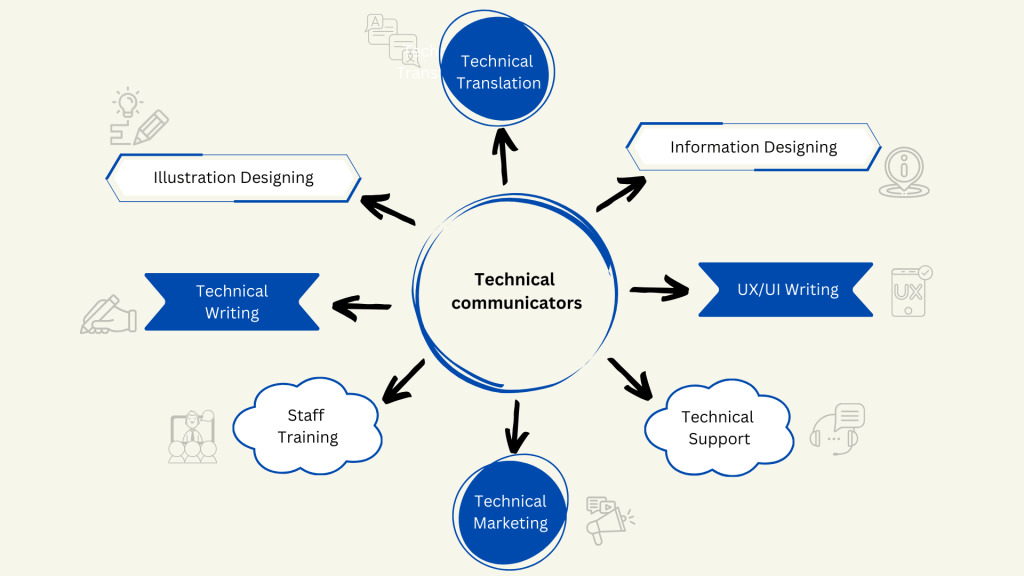
Not just that, technical communication is also a budding profession with employment opportunities in industries such as software, scientific research and development, health care, graphic designing, manufacturing, public relations, and so on. Some of the common roles that a full-time technical communicators can take are:
- Technical Writing
- Technical Marketing
- UX/UI Designing
- Information Designing
- Technical Translation
- Technical Support
- Technical Illustration
- Staff Training
- and many more..
Technical Communication and Technical Writing
Although the two terms are used interchangeably sometimes, let us understand the thin line that differentiates technical communication and technical writing.
Technical communication is a broad discipline with the prime goal of communicating technical information. As discussed above, the various types of technical communication include oral and written communication, such as audio and video conferences, presentations, technical discussions, and much more.
On the other hand, in technical writing, the information is communicated in written forms such as white papers, user manuals, proposals, reports, etc. Being the most common form of technical communication, technical writing has almost become a synonym to that. However, technically speaking, the two differ in their mode and scope significantly. Know more about technical writing and its types here.
Conclusion
As technology reaches every nook and corner, the diversity of technical communication is also expanding, thus paving the way for further advancements. No wonder, it is because technical communication offers equal benefits to businesses and customers, organizations and professionals, researchers and scientists, trainers and trainees and so on.
With the increasing scope of technical communication in various fields across industries, it is not just evolving as a specialized profession but is a requirement to perform daily tasks efficiently.
So, what are you thinking? Whether you are a professional who wants to excel in your domain or a student wishing to venture into the technical communication field, contact to learn more about the field and make a mark in your professional journey.


 JSK Writes
Leave a comment