
Have you spent hours searching for credible information to solve your problem? If yes, you are not alone. Studies report that an average knowledge worker spends nearly 2.5 hours daily searching for information. Imagine saving those precious hours – be it for your employees or users – you will get the benefit. How? Through DOCUMENTATION. But merely having documentation does not help. You need to have good documentation that is credible and boosts performance. To create one, you must understand the crucial features that differentiate the good from the rest. In this blog post, we discuss
What is good documentation?
Good documentation is all about effectively communicating specific knowledge about a product or process to its users.
Whether internal or external documentation, knowledge transfer is the fundamental objective. So, for documentation to be GOOD, it should provide the information the user needs to solve common problems, choose the right approach, learn essential details, and more.
While on one hand, good documentation guides its audience to accomplish tasks, on the other hand, it enables organizations to achieve success in several ways.
Advantages of good documentation
Increases productivity
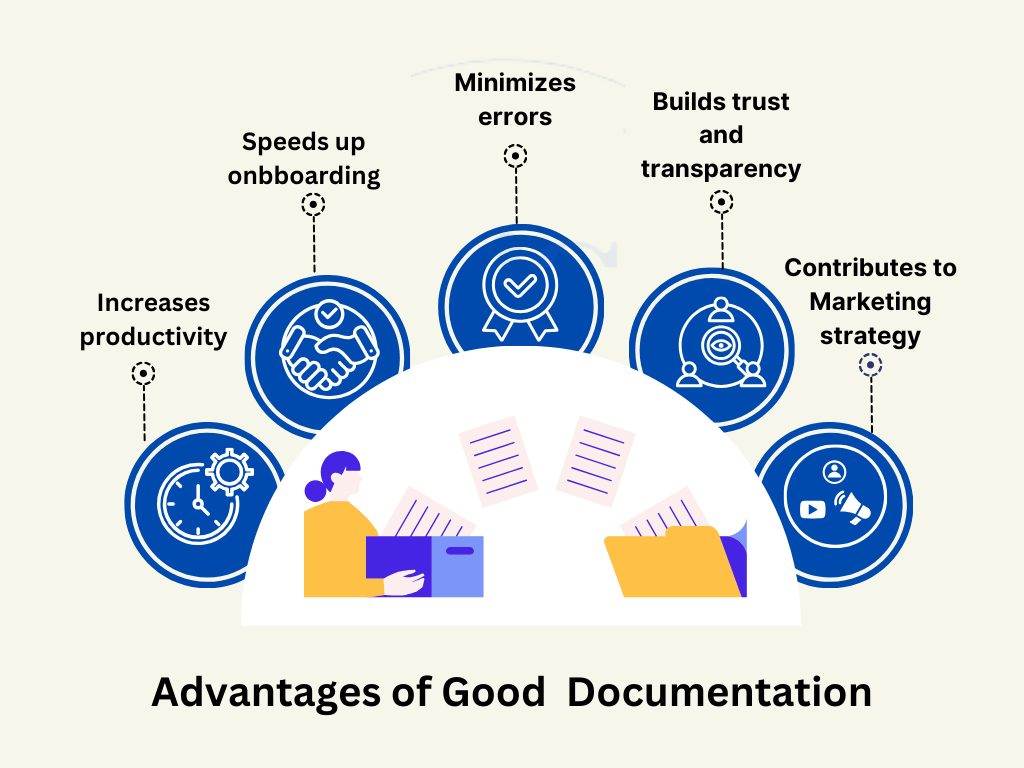
Documentation serves as a single, reliable, and organized source of truth. Users can refer to it anytime and solve their problems independently. This helps organizations save a lot of time for priority tasks. This is true for internal as well as external documents. At the same time, they help organizations minimize the need for employee training, fixing errors, and redundant tasks. Together, these time and cost savings accelerate the project’s progress.
Helps in the quick onboarding of new team members
New team members can confidently learn and understand the project and company by using respective documentation. This increases their confidence and helps in quick and smooth onboarding.
Minimizes chances of errors
By providing context, examples, definitions of terminologies, and visuals, good documentation contributes to a better understanding of the subject. As a result, there are fewer assumptions and ambiguity, thus reducing the chances of errors.
Builds trust and transparency
When organizations follow good documentation practices, they demonstrate their commitment to quality and adherence to policies and best practices. So, the users perceive the organization’s true efforts in helping them which helps build trust and transparency.
Contributes to marketing strategy
We just read how internal documentation helps create a sense of trust and transparency in employees. Similarly, quality content of end-user documentation also creates a positive impression on prospects by fostering trust, establishing originality, and opening doors for strong relationships. Therefore, it helps convert leads into customers and serves as an important marketing strategy.
However, to unlock these benefits, documentation should have some essential characteristics that make it an asset for organizations.
Characteristics of good documentation
Good documentation has the following features:
User-oriented
Good documentation is created with the needs of its target users in mind. The target users may be consumers, tech experts, management professionals, etc.

These groups vary in their educational background and expertise to understand technical concepts. Regardless of such differences, good documentation helps its users use products easily. For that, it uses the right language, technical content, style, images, format, and additional resources that reduce the burden on users.
Simple language
Simple language effectively communicates ideas. Using complex words, phrases, and terminologies leads to poor user experience and hence should be avoided.
Consider end-user documentation providing instructions on how to use the product in a simple language. It ensures that people benefit from using the technological solutions.
Illustrations and images
Images and illustrations are powerful visual tools to improve comprehension. They serve multiple purposes: clarity, engagement, accessibility, and retention.
It is important to choose the right visual element that complements the content: graphs, charts, infographics, diagrams, and videos. For effective communication, the visuals should be placed close to the relevant content.
Organized
Organized content is easy to follow. Generally, the content is formulated to proceed from understanding basics to performing advanced tasks.
Organization of content ensures a logical structure is maintained throughout the documentation. Further, well-organized documentation simplifies writers’ work when updating new features or information as and when necessary.
Consistent
Consistent formatting, terminology, and style make documentation look professional. If working on software documentation, technical writers can refer to style guides by Google developers style guide, Microsoft writing style guides, IBM style guides, or the ones provided by their respective organizations.
Similarly, every technical field follows standard guidelines and resources that emphasize consistent use of language, tone, voice, and style. Therefore, technical writers should be aware of such resources relevant to their domain and get familiar with them.
Accurate
Accurate information saves users’ time. Good documentation has no space for ambiguous statements, typos, and inaccurate instructions.
Consider a scenario where an instruction mistakenly specifies using 10 ml of medicine instead of the correct 1 ml. It can have serious implications for the patient’s health. Therefore, having accurate documentation prevents unintended consequences, and waste of time and resources.
Legible
Legibility improves the aesthetics of the document. It makes communication effective and easily accessible.
The right font size, color, text alignment, and image dimensions give readers a good experience reading the documentation. Further, legible documentation reduces misinterpretation of information leading to fewer errors.
Complete
Complete documentation is the one that covers essential and relevant supplementary information that helps users accomplish their tasks.
To ensure the documentation is complete, writers can define the scope and boundaries and synthesize the content accordingly. So organizations can be confident of user satisfaction and stronger brand perception.
Specific
Specific information helps users in many ways: quickly find information, retain user’s attention, and minimize errors. Providing an account of exceptions, prerequisites, limitations, and alternative scenarios improves the specificity of the information shared.
Vague and unclear content, on the other hand, dilutes the impact of documentation and upsets the users, which can lead to wrong perceptions about a business.
Up-to-date
Products evolve constantly to accommodate new features and users rely on documentation to learn about them. Up-to-date documentation reflects these changes by regularly updating them.
Users can quickly avail themselves of the latest features when they access the updated documentation.
Searchable
Smooth navigation is an important criterion for providing a great user experience. A searchability feature helps users quickly move to the required sections.

Including a table of contents, glossary, citations or references can improve quick access to required information. On the other hand, online documentation can leverage landing pages, hyperlinks, metadata and tags, and search boxes for easy navigation.
Inclusive
Inclusive documentation is accessible to everyone without discrimination based on gender, race, or ethnicity. Primarily, it involves using the right language, tone, and approach that meets various accessibility and learning needs.
For example, inclusive documentation uses gender-neutral terms like salesperson instead of salesman. Even using diverse images and examples can reflect inclusivity
Inclusive documentation demonstrates your commitment to social responsibility and diversity which ultimately strengthens your brand image.
So, if your documentation has these characteristics, it amplifies the success of your projects and organization.
Conclusion
In conclusion, good documentation is a must-have resource for organizations to prosper and thrive. The writing teams should ensure that their internal and external documentation have crucial characteristics that turn documentation from mere records to dynamic repositories of knowledge. Through meticulous planning, thorough preparation, and precise execution, you can create good documentation. Should you need any assistance in preparing one, connect with us.
Frequently asked questions
Is investment in good documentation helpful for startups and small-scale businesses?
Definitely. For startups, good documentation can contribute to better productivity from day one. Teams can strategically plan their work, make informed decisions, and ensure higher success rates. Most importantly, it eliminates chances of duplications and errors which can save costs and time owing to tight budget constraints.
For small-scale businesses, good documentation provides an organized system to save time and money. Further, it helps in scaling up the business.
Are there standard documentation guidelines for industrial sectors such as electrical, automobiles, and others?
Yes. In addition to having the above-mentioned characteristics, good documentation is compliant with industry-specific standards. Generally, organizations develop guidelines for documentation and technical writers follow those resources.
Further, documentation guidelines provided by the Institute of Electrical and Electronics Engineers (IEEE) are commonly used in the electrical industries. Similarly, in the automobile industry, the Society of Automotive Engineers (SAE) and Automotive Electronics Council (AEC) provide guidelines on documentation and communication protocols.


 JSK Writes
Leave a comment