

If writing is about adding the right ingredients to prepare content, then editing is the final touch that makes your content more engaging and impactful before it is served to the readers. That is, editing is the quality control step between content creation and publication that ensures the target audience can smoothly solve their problem by using the information.
Editing involves removing lingual and conceptual errors, improving language, incorporating conciseness, and checking facts. Good editing shapes the content to make it easily digestible by users. However, the benefits of editing span beyond ensuring content and grammar. In this blog, you will read about the role editing plays in generating effective technical content and its 5 indispensable benefits.
Role of Editing
Editing is often conceived as a process of correcting grammatical errors. However, the purpose of editing a technical document is to create its best version by evaluating it on multiple fronts:
- Ensure accuracy
- Improve clarity
- Enhance readability
- Foster collaboration
- Verify compliance with the guidelines
- Boost SEO
- Maintain consistency in tone and style
- Optimize for localization
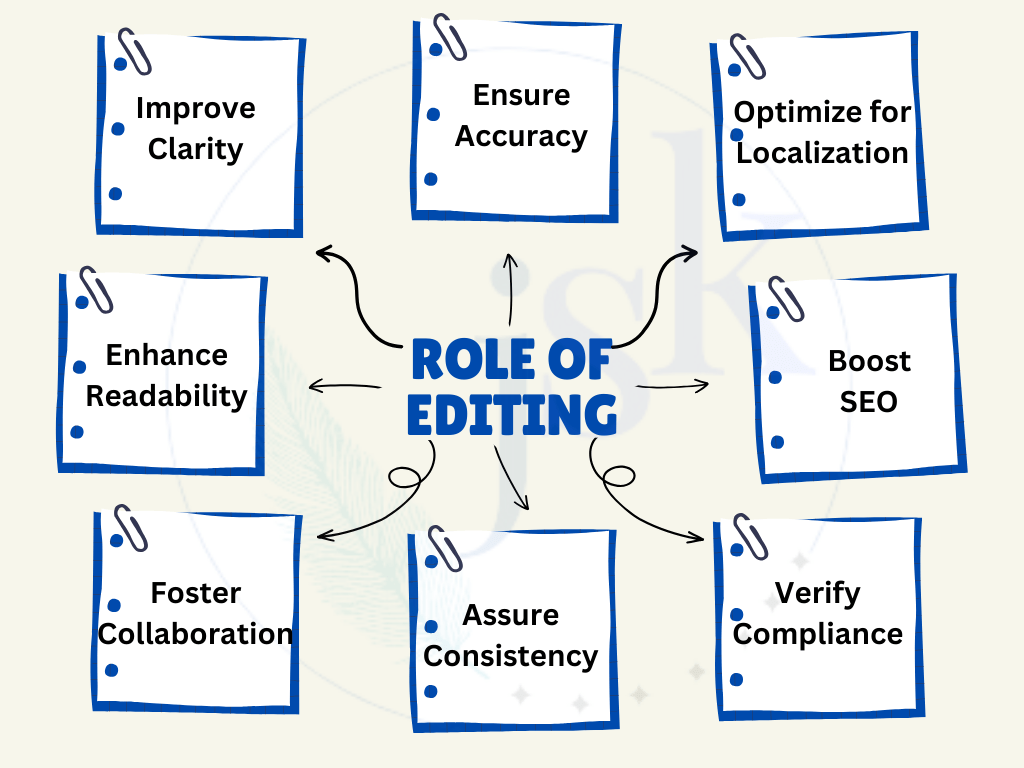
Therefore, editing refines your content to achieve precision, authority, and professional standards. Apart from these, editing has much more to offer. Let us delve into some implied benefits of editing and discover the power of effective communication and a meticulous editing process.
Benefits of Editing
1. Promotes reader engagement
Effective technical content isn’t just about delivering information – it’s about keeping your reader engaged.
Can we expect readers to stick around with content riddled with grammatical errors, jargon overload, or unclear explanations? Confused readers would soon end their journey on your page and even worse, would land on the competition’s page providing clear content. And believe it or not, it was not just the reader moving ahead but an opportunity lost.
On the other hand, a well-edited piece acts like a bridge. It smooths the flow, clarifies those technical terms, and uses concise language to get your point across. The clear, engaging, and problem-solving content translates into a satisfied reader who retains the information and develops a positive impression of your organization – a win-win for everyone.
2. Improves customer experience
Customers not only seek information but also want it organized, precise, readable, and comprehensive. Editing ensures that all of these expectations are met by checking the accuracy and completeness of the information, reducing unnecessary information, and removing ambiguities—all of which translate into a better customer experience.
A delightful customer experience doesn’t end at the document or product. Satisfied customers become brand advocates, sharing their positive experiences and indirectly fueling the brand’s marketing efforts.
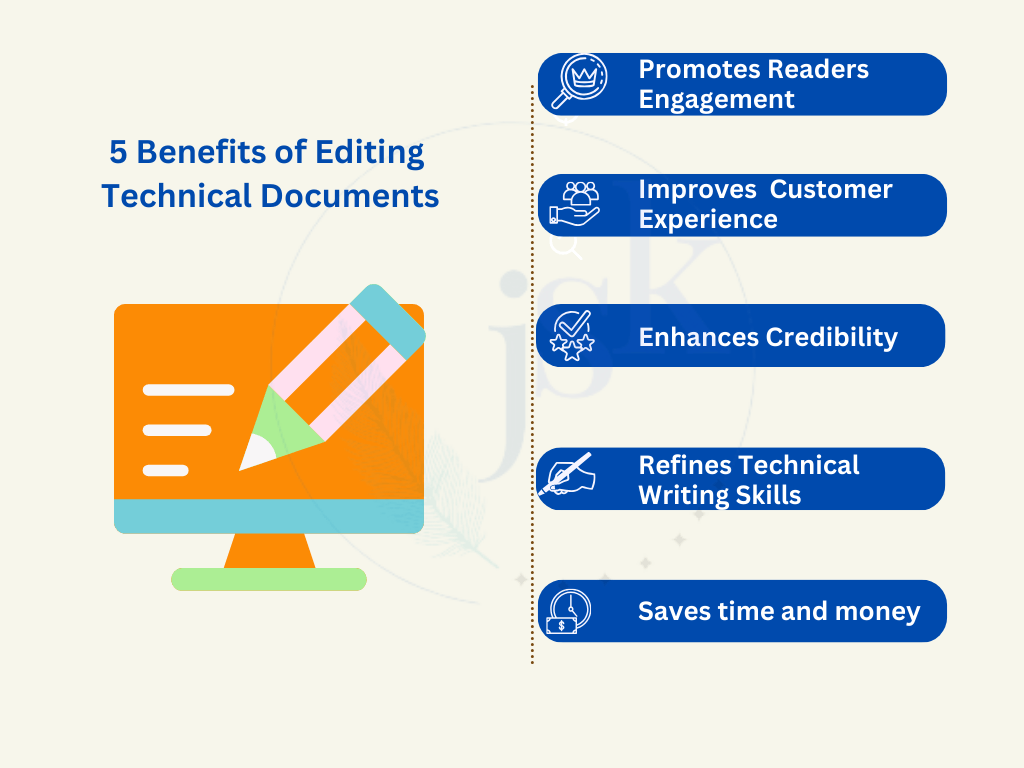
3. Enhances credibility
Technical information is complex and it is all the more crucial to present it with the utmost precision. An erroneous technical document not only causes user annoyance due to wasted time but may also result in a safety hazard in some cases. Such events cause a loss of trust in the brand, which is hard to recover.
On the other hand, editing your technical documents for factual accuracy and clarity helps users utilize information correctly and solve their problems efficiently. This enhances the credibility of your technical content and creates a positive impression about the product and the business.
4. Help technical writers improve their writing
Writing is a continuously evolving skill that flourishes with practice and feedback. In a collaborative working environment, seasoned editors not only monitor content quality but also help writers improve their craft.
The editing process involves editors communicating with technical writers on various quality aspects of the writing. These could relate to maintaining the accuracy of the information, enhancing the presentation or visual appeal, or fixing any deviations from the required format.
Such discussions and constructive feedback from editors give technical writers valuable opportunities to grow. It helps them identify their strengths and weaknesses, improve their content quality, and emerge as confident writers.
5. Saves time and money
Unedited documents are likely to contain errors and ambiguities. This may hinder customers’ understanding of the technical information and experience with the product. The consequences are – a high volume of consumer calls, emails, or complaints requiring additional time and resources. Sometimes, consumers even prefer to switch to other brands due to such hassles and unpleasant experiences, affecting the brand reputation and consumer base.
Editing is a proactive quality assurance measure that can significantly reduce the chances of such scenarios. No doubt, it saves you from the loss of time and money while building the consumers’ trust.
Conclusion
Editing as a quality control measure helps create superior-quality documents for the target users. Besides, editing offers several benefits spanning different areas of your organization’s growth and development. Therefore, regardless of the size and complexity of technical documents, the benefits of editing cannot be overlooked. Do you also want to claim these benefits but have no dedicated editor? Rely on my editorial services for your next project. Click here to reach out.
Frequently-Asked Questions (FAQs)
1. How is editing different from proofreading?
Editing is an iterative process where different aspects are checked at different stages. For example, developmental editing checks the organization and structure of the document, while copy editing focuses on grammatical errors such as typos, spelling, punctuation, and style.
Similarly, proofreading is a type of editing that is done as a final quality checkpoint before publishing a document. It involves identifying minor errors and inconsistencies in text and format just before the “Publish” button is hit.
2. How are the responsibilities of editors different from those of writers?
Writers and editors can have similar responsibilities but differ in how they contribute their skills to generate a quality document. Some of the responsibilities of writers and editors are listed below.
| Writers | Editors |
| Research and arrange information to write the technical content. | Research to check the accuracy of information and inspect the structuring of the content. |
| Follow the standard guidelines and adhere to style guides while generating content. | Identify any non-compliance with the guidelines and suggest new guidelines, if needed. |
| Interview SMEs to gather relevant information. | Discuss with SMEs to fact-check and integrate fresh perspectives if needed. |
| Write to minimize the need for editing and proofreading by learning from previous comments and suggestions from editors. | Review the content and provide constructive feedback. |
3. Can AI tools minimize the need for editing?
Artificial Intelligence has changed the way we used to work a few years back, and it will be silly to miss what it has to offer. There are several AI-based editing tools that offer quick grammar and spelling checks. Some of them also provide better alternatives for vocabulary as well as sentence arrangements. However, these AI-based tools have their share of limitations. After all, they are just tools.
As mentioned above, these tools do a good job when it comes to proofreading. However, if you need editing from content organization, accuracy, contextual, and flow perspective, editing tools will not suffice. You require a professional and experienced human editor for in-depth content editing to generate real value out of your content.


 JSK Writes
Leave a comment