
Your property but claimed by others as their own?
This is what plagiarism looks like.
Plagiarism is a serious ethical misconduct that involves stealing other’s ideas or intellectual property and presenting them as theirs. Writers today need a strong grasp of plagiarism both to avoid unintentional mistakes and to protect their own work. In addition to using plagiarism detection tools effectively, a thorough understanding of plagiarism helps improve your writing skills and uphold ethical standards.
If you are trying to build your credibility alongside expertise, this post is for you. Explore different types of plagiarism, their consequences, and how to avoid them.
Different Types of Plagiarism
The standard categorization of different plagiarism types does not exist. However, the following are the most common types one may encounter:

Direct Plagiarism
When a work has content copied word-for-word from another source without correctly citing the source, it is called direct plagiarism.
This includes copying a few sentences, paragraphs, or even short phrases. The original source may be a book, an online resource, or any other media.
People may use quotation marks to indicate the copied content but that is not a standard practice unless backed by citation.
Sometimes, people tend to use quotation marks to highlight borrowed content, but putting it in quotes does not save you from plagiarism offense.
Paraphrasing Plagiarism
This is a common type of plagiarism in which an author may paraphrase the content in a way that closely resembles the source. The changes to the original work may involve substituting synonyms or minor changes to the sentence structure and other aspects of copied sections. However, it still amounts to the act of plagiarism.
While paraphrasing tools may help you communicate the same message differently, you need to add originality through your knowledge and understanding of the topic.
Mosaic Plagiarism
Mosaic art is aesthetically pleasing, reflecting human creativity and craftsmanship. However, the same is not true for mosaic plagiarism.
Just like mosaic art, mosaic plagiarism involves assembling bits and pieces from various sources without providing proper citations. This is also called patchwork plagiarism.
This mosaic content is often difficult to identify as it originates from different sources and is presented in a way that is not easily detectable. While challenging to detect, writers should prioritize originality and avoid mosaic plagiarism.
Self-Plagiarism
Self-plagiarism refers to the act of reusing your own previously published or submitted work without proper citation. Mainly, it highlights a lack of interest in creating new work.
Self-plagiarism encompasses different scenarios:
- Reusing significant portions of text, including copying entire passages or using the same methodology or data from a previous work without acknowledging it.
- Submitting the same work twice or republishing content you’ve already published elsewhere (without permission from the publisher).
Accidental plagiarism
Accidental plagiarism occurs when you unintentionally use someone else’s ideas or words without giving them proper credit. It typically arises from ineffective rephrasing, inadequate notetaking, and a lack of understanding regarding proper citation practices.
Consequences of Plagiarism
Plagiarism of any kind can result in some or all of the following consequences:
Loss of reputation and credibility
If you are found to have plagiarized, it sends a message to your client and readers that you are not trustworthy enough to produce original work or conduct proper research.
This can damage your reputation as an expert and make it difficult for others to take your work seriously. Consequently, it reduces your future collaborations or opportunities.
Termination of employment
Many organizations have strict policies against plagiarism. If an employee is caught plagiarizing company materials, presentations, or reports, his employment is terminated immediately. This can have significant financial repercussions and make it difficult to find new employment, especially in the same field.
Companies consider plagiarism seriously because it reflects poorly on their brand and professionalism. Further, it affects client relationships and puts the company at risk of lawsuits.
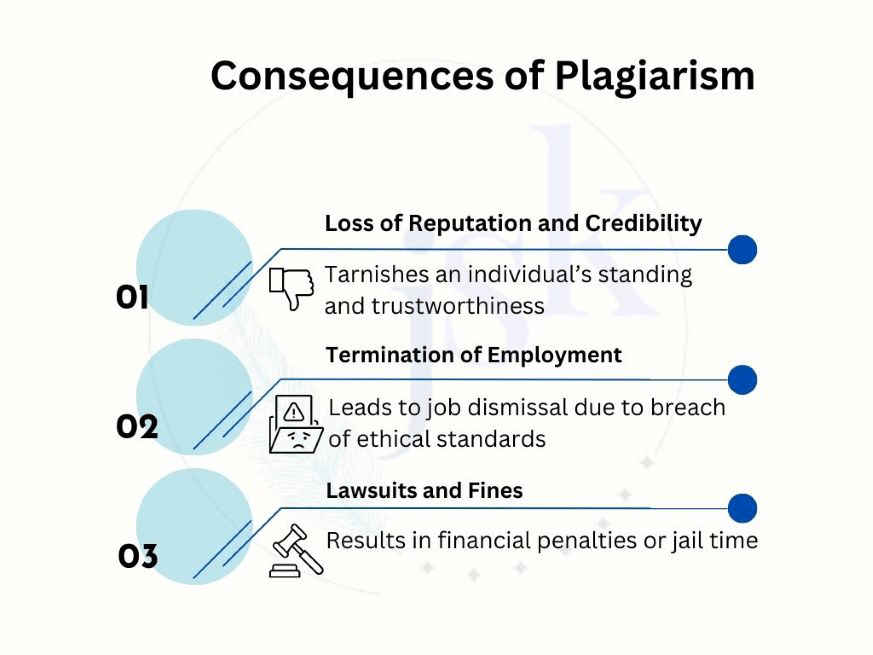
Lawsuits and fines
Copyright law protects the original works of authors and creators. When somebody plagiarizes, they violate the copyright law, and the act is considered copyright infringement. The original author has all the rights to sue you for damages.
This can result in hefty fines and even court-ordered punishments.
How to Avoid Plagiarism
Proper citation and referencing techniques
In academic settings, learn and practice using specific citation styles like APA, MLA, and Chicago Manual of Style. Similarly, when using information from other sources in media articles and publications, etc, note down the resources used for your work towards the end.
If you develop the habit of meticulously citing your references, you significantly reduce the chances of plagiarism.
Apply your critical thinking and analysis skills
Do not just serve informative content. When using information, always process it by applying your experience, analytical skills, and critical thinking. This makes you offer value for the reader’s time and interests. On the other hand, it helps you build your identity through your unique work.
Cultivate your writing style
The best way to avoid plagiarism is to cultivate your writing style. As a writer, you will benefit from developing skills that will promote your growth and keep your work away from chances of plagiarism. Read widely, take notes, and practice expressing yourself clearly and concisely. The more you refine your voice, the easier it becomes to express ideas in your own words.
Use plagiarism checker tools
Even if you have followed the above steps correctly, use plagiarism checker tools to ensure your content is plagiarism-free. This helps detect accidental plagiarism so that you can take steps to correct it before publishing your work.
Conclusion
Plagiarism is a bad grade. It can tarnish your reputation, jeopardize your education or career, and even lead to legal troubles. Therefore, by understanding the different forms of plagiarism and learning how to avoid them, you can protect yourself and ensure your ideas and hard work shine. Remember, integrity is the foundation of any successful writer. Let people know you through your authentic work.


 JSK Writes
Leave a comment